

Top 30 Delivery Based Stock Analysis
Hello Readers,
Navigating the complexities of the stock market can be a daunting task, especially with the constant influx of data and fluctuating trends. For many investors looking for an edge, understanding delivery-based stock analysis has become a cornerstone of informed decision-making. As we look towards 2026, the ability to interpret market sentiment and identify long-term investment opportunities through delivery data is more crucial than ever. This comprehensive guide will explore the top 30 delivery based stock analysis techniques, empowering you to make smarter choices and potentially unlock significant gains in your portfolio.
1. Interpreting Delivery Volume Trends

Understanding delivery volume trends is fundamental to discerning genuine market movements from speculative noise. High delivery volume accompanied by rising prices often signals strong institutional accumulation and a potential bullish trend, suggesting investors are taking long-term positions rather than day trading. Conversely, increasing delivery volume during a price decline could indicate smart money exiting positions, warning of potential further downsides for a stock.
In 2026, consistently monitoring these trends allows investors to identify stocks with robust underlying demand or significant selling pressure. It helps distinguish between short-term volatility and more sustained shifts in market sentiment, making it a critical aspect of any sound investment strategy. This initial analysis forms the bedrock for more advanced delivery-based evaluations.
| Delivery Trend | Price Action | Market Implication |
|---|---|---|
| High Volume Delivery | Rising Prices | Strong Accumulation (Bullish) |
| High Volume Delivery | Falling Prices | Significant Distribution (Bearish) |
| Low Volume Delivery | Flat/Volatile Prices | Lack of Conviction |
2. Percentage of Delivery to Traded Quantity

The percentage of delivery to traded quantity is a powerful indicator that reveals the conviction behind market participants. A consistently high percentage suggests that a large portion of the shares traded are being taken for actual delivery into demat accounts, indicating long-term buying or selling interest rather than intraday speculation. This metric is invaluable for gauging the strength of a trend.
For investors in 2026, analyzing this percentage helps to confirm whether price movements are backed by genuine positional trades. A stock showing a high delivery percentage during an upward price movement implies strong fundamental interest, making it a more reliable candidate for sustained growth. Conversely, a low percentage, even with significant volume, points to speculative trading.
| Delivery Percentage | Implication | Investment Insight |
|---|---|---|
| > 60% | High Conviction | Strong Positional Interest |
| 40-60% | Moderate Conviction | Mixed Trading Activity |
| < 40% | Low Conviction | Dominant Intraday Trading |
3. Accumulation and Distribution Cycles

Identifying accumulation and distribution cycles through delivery data offers deep insights into institutional activity. Accumulation phases are characterized by rising delivery volumes and stable or gradually increasing prices, as smart money quietly buys shares. Distribution, conversely, sees increasing delivery volume during periods of stagnant or slightly falling prices, as large players offload their holdings.
Understanding these cycles is vital for investors in 2026 aiming to align their strategies with major market players. Catching a stock during its accumulation phase can lead to substantial gains as prices eventually break out. Recognizing early signs of distribution can help investors exit positions before significant downturns, protecting capital and optimizing returns.
| Cycle Phase | Delivery Volume | Price Action | Investor Action |
|---|---|---|---|
| Accumulation | Rising | Stable/Gradual Rise | Consider Buying |
| Distribution | Rising | Stable/Gradual Fall | Consider Selling |
| Markup | Volatile | Sharp Rise | Hold/Trail Stop |
4. Delivery Volume vs. Price Divergence
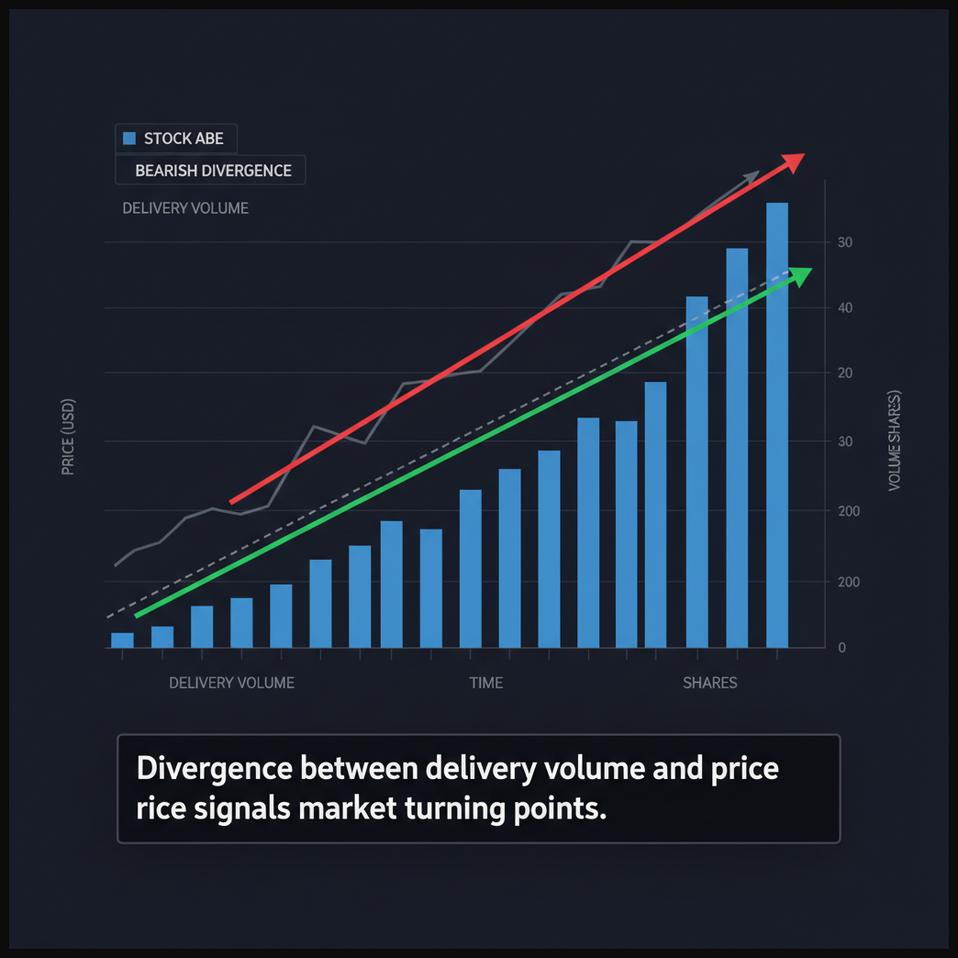
Analyzing divergence between delivery volume and price action can signal critical turning points in a stock. If a stock’s price is rising but its delivery volume is decreasing, it suggests that the rally lacks conviction from long-term investors and might be unsustainable. This bearish divergence warns that the uptrend could soon reverse as speculative interest wanes.
Conversely, a bullish divergence occurs when the price falls, but delivery volume either increases or remains stable, indicating that strong hands are accumulating at lower levels. This suggests a potential bottoming out and a subsequent reversal. Mastering these divergences in 2026 can provide early signals for market shifts.
| Price Action | Delivery Volume | Divergence Type | Potential Outcome |
|---|---|---|---|
| Rising | Decreasing | Bearish Divergence | Trend Reversal Down |
| Falling | Increasing | Bullish Divergence | Trend Reversal Up |
| Rising | Increasing | Confirmation | Trend Continuation Up |
5. High Delivery, Low Volume Days

High delivery on low total traded volume days can be a significant indicator. When a substantial percentage of a stock’s limited daily volume is taken for delivery, it often suggests a stealthy accumulation or distribution by informed players. These days might not grab headlines but can be crucial for uncovering underlying market shifts.
For discerning investors in 2026, observing these patterns helps identify periods where smart money is quietly operating without attracting broad attention. Such days, particularly in illiquid stocks, can sometimes precede significant price movements as larger entities subtly build or reduce their positions, making it a key component of stock market analysis.
| Scenario | Total Volume | Delivery Percentage | Implication |
|---|---|---|---|
| Stealth Accumulation | Low | High | Strong Positional Buying |
| Stealth Distribution | Low | High (Selling) | Strong Positional Selling |
| Typical Trading | Normal | Varies | General Market Activity |
6. Delivery Volume Spikes and Supports

Delivery volume spikes at key support or resistance levels can provide strong validation for these price barriers. A significant increase in delivery volume as a stock approaches a support level, coupled with a bounce, confirms strong buying interest at that price point. This indicates that long-term investors are stepping in to defend the level.
Similarly, a spike in delivery volume at a resistance level, followed by a rejection, signals significant distribution by holders. Monitoring these interactions in 2026 helps identify reliable entry and exit points, as they represent areas where market participants are actively committing capital for sustained periods, making them valuable technical analysis tools.
| Price Level | Delivery Volume | Price Action | Interpretation |
|---|---|---|---|
| Support | Spike (Rising) | Bounce | Strong Buying Interest |
| Resistance | Spike (Falling) | Rejection | Strong Selling Interest |
| Breakout | Spike (Rising) | Sustained Move | Confirmed Breakout |
7. Average Delivery Price Analysis

Calculating the average delivery price over a period can reveal the cost basis of long-term investors, offering a crucial psychological and technical level. When the current market price approaches or falls below this average, it might indicate that existing long-term holders are facing losses, potentially leading to increased selling pressure or an attractive entry point for new buyers.
Conversely, if the price is significantly above the average delivery price, it suggests that long-term holders are comfortably in profit, reducing immediate selling pressure. This analysis, especially relevant for 2026, helps identify areas of potential support or resistance where large groups of investors have significant stakes, guiding investment strategy insights.
| Current Price vs. Avg. Delivery Price | Investor Sentiment | Potential Action |
|---|---|---|
| Below Avg. Delivery Price | Existing Holders in Loss | Potential Support/New Buying |
| Above Avg. Delivery Price | Existing Holders in Profit | Reduced Selling Pressure |
| Near Avg. Delivery Price | Neutral/Consolidation | Watch for Breakout |
8. Delivery Volume Moving Averages

Applying moving averages to delivery volume smooths out daily fluctuations, making it easier to identify underlying trends in institutional activity. A rising delivery volume moving average, especially during a price rally, confirms increasing long-term commitment. Conversely, a falling average during a price decline reinforces selling pressure.
In 2026, using moving averages like the 5-day or 20-day delivery volume average helps distinguish between temporary spikes and sustained shifts in investor interest. This simple yet effective tool provides a clearer picture of whether smart money is consistently accumulating or distributing shares, offering valuable confirmation for price trends and helping refine delivery volume analysis strategies.
| Delivery Volume MA | Price Trend | Interpretation |
|---|---|---|
| Rising MA | Rising Price | Strong Accumulation Confirmation |
| Falling MA | Falling Price | Strong Distribution Confirmation |
| Flat MA | Consolidation | Neutral Long-Term Interest |
9. Delivery Volume with Open Interest (Futures & Options)

Combining delivery volume analysis with open interest data from the futures and options (F&O) segment can provide a holistic view of market sentiment, especially for stocks with F&O contracts. High delivery volume in the cash market coupled with a significant increase in open interest for futures contracts can signal strong directional conviction from larger players, expecting a sustained move.
Conversely, a decline in open interest alongside high delivery could indicate squaring off of existing positions. For investors navigating 2026 markets, this combined analysis helps to gauge whether long-term cash market conviction is being mirrored or contradicted by speculative activity in derivatives, providing a more complete picture of a stock’s outlook.
| Delivery Volume | Open Interest | Implication | Combined Signal |
|---|---|---|---|
| High | Rising | Strong Directional Bias | Bullish/Bearish Confirmation |
| Low | Rising | Speculative Build-up | Caution Advised |
| High | Falling | Position Unwinding | Potential Reversal |
10. Sectoral Delivery Analysis

Analyzing delivery volumes across an entire sector can reveal broader trends and rotational plays within the market. If multiple stocks within a particular sector show increasing delivery volume and positive price action, it suggests that institutional money is flowing into that sector, indicating potential outperformance. This can be a leading indicator for sector-specific rallies.
For portfolio managers and thematic investors in 2026, sectoral delivery analysis helps identify which industries are currently favored by long-term investors. It allows for strategic allocation of capital into sectors exhibiting strong underlying accumulation, thereby improving the chances of capturing broader market movements and enhancing overall portfolio returns.
| Sector Delivery Trend | Price Action (Sector) | Market Insight |
|---|---|---|
| Rising Delivery (Many Stocks) | Sector Price Rising | Institutional Inflow, Sectoral Rally |
| Falling Delivery (Many Stocks) | Sector Price Falling | Institutional Outflow, Sectoral Downtrend |
| Mixed Delivery | Consolidation/Mixed | Lack of Clear Sectoral Bias |
11. Intraday vs. Delivery Volume Breakdowns

Understanding the ratio of intraday trading volume to delivery volume on a daily basis provides critical context to price movements. Days with high intraday volume but low delivery percentage indicate significant speculative activity, suggesting that price movements might be fleeting and unsustainable. Such days often lead to whipsaws and false breakouts.
Conversely, days with a high delivery percentage, even if total volume is moderate, indicate genuine long-term interest. In 2026, differentiating between these two types of activity helps investors filter out market noise and focus on price movements backed by strong conviction, leading to more reliable trading and investing signals.
| Volume Type | Market Implication | Impact on Price Trend |
|---|---|---|
| High Intraday Volume | Short-term Speculation | Volatile, Unreliable Trends |
| High Delivery Volume | Long-term Conviction | Sustainable, Reliable Trends |
| Balanced Volume | Normal Market Activity | Mixed Signals |
12. Delivery Volume on Breakouts and Breakdowns

Analyzing delivery volume during price breakouts or breakdowns is crucial for validating the strength of these moves. A genuine breakout above a resistance level should be accompanied by a significant surge in delivery volume, indicating strong buying interest from long-term investors. Without this confirmation, a breakout might be a bull trap.
Similarly, a breakdown below a support level is more credible when it’s accompanied by increased delivery volume, signaling strong distribution. For investors in 2026, confirming these price actions with robust delivery data helps avoid false signals and improves the success rate of trades based on technical patterns, reinforcing delivery based analysis.
| Price Action | Delivery Volume | Validation | Trading Signal |
|---|---|---|---|
| Breakout Up | High Spike | Strong Buy Signal | Enter Long Position |
| Breakdown Down | High Spike | Strong Sell Signal | Exit Long/Enter Short |
| Weak Breakout | Low/Normal | False Signal | Avoid/Caution |
13. Delivery Volume and Volatility Correlation

Examining the relationship between delivery volume and a stock’s volatility can reveal important behavioral patterns. Periods of high delivery volume coupled with low volatility might suggest quiet accumulation by large investors, who prefer to buy without significantly moving the price. This can be a precursor to a strong upward move.
Conversely, high delivery volume during periods of extreme volatility could indicate panic selling or aggressive buying after major news, signifying strong conviction during uncertain times. For investors in 2026, understanding this correlation helps differentiate between speculative volatility and fundamental conviction, aiding in more stable investment decisions.
| Delivery Volume | Volatility | Market Behavior |
|---|---|---|
| High | Low | Quiet Accumulation/Distribution |
| High | High | Strong Conviction in Volatile Market |
| Low | High | Speculative/Noise-Driven Volatility |
14. Long-Term Delivery Accumulation Patterns

Identifying patterns of consistent long-term delivery accumulation over several weeks or months is a strong bullish signal. This occurs when a stock repeatedly shows a high percentage of delivery volume on positive price days, indicating that institutions or long-term investors are steadily building their positions. These patterns are often precursors to major upward price movements.
For patient investors in 2026, spotting these persistent accumulation patterns offers an opportunity to enter positions alongside smart money before the broader market recognizes the stock’s potential. It’s a testament to fundamental strength and growing confidence in the stock’s future prospects, forming a key aspect of advanced investment strategies and techniques.
| Pattern Duration | Delivery Percentage | Price Action | Signal Strength |
|---|---|---|---|
| Weeks/Months | Consistently High | Stable/Gradual Rise | Very Strong Bullish | Days/Week | High | Sharp Rise | Strong Bullish |
| Irregular | Variable | Volatile | Unclear Signal |
15. Short-Term Delivery Spikes on Reversals

Observing short-term delivery spikes during potential price reversals can provide early confirmation of a trend change. For instance, after a prolonged downtrend, a sudden surge in delivery volume on an upward price day suggests that new buying interest is emerging, potentially signaling a bottoming out. This indicates that long-term investors are stepping in.
Similarly, a spike in delivery volume on a downward price day after an uptrend could indicate profit-booking or fresh selling by institutions, hinting at a top. Identifying these spikes in 2026 allows agile traders and investors to capitalize on early trend reversals, maximizing potential gains or minimizing losses as the market shifts direction.
| Trend | Delivery Spike | Price Action | Reversal Signal |
|---|---|---|---|
| Downtrend | Rising (on Up Day) | Price Rises | Bullish Reversal |
| Uptrend | Rising (on Down Day) | Price Falls | Bearish Reversal |
| Consolidation | Mixed | Flat/Volatile | No Clear Signal |
16. Delivery Volume in Penny Stocks

Analyzing delivery volume in penny stocks requires extra caution but can yield high rewards if interpreted correctly. Due to their low prices and often illiquid nature, even small institutional buying or selling can significantly impact their delivery volumes. A sudden, consistent rise in delivery percentage in a penny stock, especially on news, could indicate smart money taking positions.
However, penny stocks are also prone to manipulation. Therefore, investors in 2026 must cross-reference high delivery volume with fundamental news and strong financial health to avoid speculative traps. When genuine interest is confirmed, delivery data can highlight hidden gems with explosive growth potential.
| Penny Stock Scenario | Delivery Volume | Fundamental News | Investment Implication |
|---|---|---|---|
| Potential Gem | Consistent High % | Positive | Possible Strong Accumulation |
| Speculative Trap | Spiky, Inconsistent | Negative/None | High Risk, Avoid |
| No Interest | Low/Normal | None | Avoid/Low Potential |
17. Delivery Volume on Ex-Dividend Dates

Delivery volume behavior around ex-dividend dates can provide insights into short-term trading vs. long-term holding intentions. A drop in delivery volume or an increase in intraday trading on or just before the ex-dividend date suggests that some investors are buying purely for the dividend capture, planning to sell immediately after.
Conversely, stable or high delivery volume around these dates, even with price fluctuations, indicates that investors are holding for the long term, valuing the company’s fundamentals beyond just the dividend payout. For investors in 2026, this analysis helps differentiate between transient interest and genuine long-term commitment.
| Ex-Dividend Date | Delivery Volume | Investor Behavior | Market Interpretation |
|---|---|---|---|
| Around Date | Drop/Intraday Spike | Dividend Capture | Short-term Interest |
| Around Date | Stable/High | Long-term Holding | Fundamental Conviction |
| Post-Dividend | Increase | New Accumulation | Positive Sign |
18. Delivery Volume with Corporate Actions

Analyzing delivery volume in conjunction with corporate actions such as mergers, acquisitions, stock splits, or rights issues can offer invaluable insights. A significant increase in delivery volume after a positive corporate announcement often confirms that smart money is accumulating shares, signaling confidence in the future prospects of the merged entity or the benefits of the split.
Conversely, a decrease in delivery during a perceived negative corporate action, accompanied by falling prices, indicates institutional exit. For investors in 2026, correlating delivery data with these events helps validate market reactions and discern long-term investor sentiment from short-term speculative noise, crucial for effective stock market analysis.
| Corporate Action | Delivery Volume | Price Action | Market Sentiment |
|---|---|---|---|
| Positive News (M&A) | Surge | Rising | Strong Institutional Buying |
| Negative News | Decrease/Increase (Selling) | Falling | Institutional Exit |
| Stock Split | Often Rises Post-Split | Volatile Initially | Increased Liquidity/Interest |
19. Delivery Volume in Bull vs. Bear Markets

The interpretation of delivery volume differs significantly between bull and bear markets. In a bull market, high delivery volume on up days is typically a strong bullish signal, confirming sustained buying. In a bear market, however, high delivery volume on down days might indicate aggressive distribution or capitulation, signaling further declines.
Conversely, high delivery volume on up days in a bear market could signal a potential bottom or short covering. For investors in 2026, adjusting the interpretation of delivery data to the prevailing market cycle is crucial for making accurate assessments and avoiding misjudgment of signals, leading to more resilient delivery based analysis.
| Market Phase | Delivery Volume (Up Day) | Delivery Volume (Down Day) | Interpretation |
|---|---|---|---|
| Bull Market | High (Bullish) | Low (Healthy Correction) | Strong Trend Confirmation |
| Bear Market | Low (Weak Bounce) | High (Further Decline) | Weakness Confirmation |
| Transition | Volatile | Volatile | Uncertainty, Watch for Reversal |
20. Delivery Volume with Price Action Rejection

Observing delivery volume during price action rejections, such as at trendlines, moving averages, or Fibonacci levels, offers enhanced confirmation. If a stock attempts to break above a resistance level but is sharply rejected, and this rejection is accompanied by a surge in delivery volume on the downside, it signals strong institutional selling pressure.
Similarly, a rejection from a support level with an increase in delivery volume on the upside confirms strong buying. For technical traders in 2026, combining price rejection patterns with delivery volume provides a higher conviction signal for entry or exit points, making the analysis of candlestick patterns more reliable.
| Price Rejection Type | Delivery Volume | Price Action | Signal Strength |
|---|---|---|---|
| Resistance Rejection | Spike (Down) | Sharp Fall | Strong Bearish |
| Support Rejection | Spike (Up) | Sharp Rise | Strong Bullish |
| Weak Rejection | Low/Normal | Consolidation | Neutral/Caution |
21. Delivery Volume vs. Historical Averages

Comparing current delivery volumes and percentages against their historical averages can reveal significant shifts in investor behavior. A sustained period of higher-than-average delivery volume, particularly if accompanied by positive price action, suggests a fundamental change in institutional interest towards the stock, indicating strong underlying momentum.
Conversely, a consistent drop below historical averages might signal waning interest or a shift towards more speculative short-term trading. For long-term investors in 2026, tracking these deviations from historical norms helps identify stocks that are either gaining or losing long-term favor, guiding their investment strategy insights.
| Delivery Volume/Percentage | Historical Comparison | Interpretation |
|---|---|---|
| Consistently High | Above Average | Increased Long-Term Interest |
| Consistently Low | Below Average | Decreased Long-Term Interest |
| Volatile | Fluctuating around Avg. | Unclear Trend |
22. Delivery Volume with Volume Profile

Integrating delivery volume analysis with a volume profile tool provides a deeper understanding of where actual shares are being held by long-term investors across different price levels. High delivery volume at a particular price band within the volume profile indicates strong accumulation or distribution zones where significant capital is committed.
For traders and investors in 2026, identifying these “delivery-rich” price zones helps determine stronger support and resistance levels compared to those based solely on total volume. This precise understanding allows for more accurate entry and exit strategies, as these levels represent points of high conviction for long-term players, enhancing stock market analysis.
| Volume Profile Zone | Delivery Volume in Zone | Interpretation |
|---|---|---|
| High Volume Node | High Delivery | Strong Accumulation/Distribution Zone |
| Low Volume Node | Low Delivery | Lack of Conviction/Weak Zone |
| Value Area | Consistent Delivery | Fair Value for Positional Traders |
23. Delivery Volume and Relative Strength

Combining delivery volume with a stock’s relative strength (RS) against the broader market or its sector is a potent strategy. A stock showing increasing relative strength, especially when accompanied by strong delivery volume, suggests that smart money is actively accumulating it even when the overall market might be neutral or declining.
This indicates that the stock is a leader and likely to outperform. For growth-oriented investors in 2026, identifying stocks with both strong relative strength and high delivery volume can pinpoint future market outperformers, helping to construct robust portfolios that can withstand market fluctuations and deliver superior returns.
| Relative Strength | Delivery Volume Trend | Investment Signal |
|---|---|---|
| Increasing RS | Rising Delivery | Strong Outperformer, Buy |
| Decreasing RS | Falling Delivery | Underperformer, Avoid/Sell |
| Flat RS | Mixed Delivery | Neutral, Watch for Trends |
24. Delivery Volume in Pre-Market/Post-Market Sessions

While delivery data typically pertains to regular trading hours, understanding how pre-market and post-market activity influences subsequent regular session delivery can be insightful. Unusual volume in extended hours, followed by a high delivery percentage in the next regular session, suggests that significant news or events are prompting long-term investors to take positions.
For active traders and institutional observers in 2026, monitoring this interplay can provide a forward-looking perspective on upcoming market sentiment and potential gaps in price. It helps gauge whether after-hours buzz translates into genuine long-term commitment, thereby refining overall delivery volume analysis strategies.
| Extended Hours Activity | Next Day Delivery Volume | Market Implication |
|---|---|---|
| High Volume | High Delivery % | Strong Conviction from News |
| High Volume | Low Delivery % | Speculative Reacting to News |
| Low Volume | Normal Delivery % | No Significant Overnight Shift |
25. Delivery Volume with Candlestick Patterns

Combining delivery volume analysis with classic candlestick patterns offers a powerful confirmation tool for predicting price movements. For example, a bullish engulfing pattern or a hammer candlestick formation, if accompanied by a significant surge in delivery volume, gains much higher credibility as a reversal signal, indicating that smart money is indeed stepping in.
Conversely, a bearish engulfing or shooting star pattern with rising delivery volume on the downside suggests strong distribution. In 2026, this combined approach helps filter out weak or false signals from candlestick patterns, enabling investors to act on only the most reliable technical indicators for their delivery based analysis.
| Candlestick Pattern | Delivery Volume | Signal Strength |
|---|---|---|
| Bullish Engulfing/Hammer | High Spike | Very Strong Buy Signal |
| Bearish Engulfing/Shooting Star | High Spike | Very Strong Sell Signal |
| Doji/Spinning Top | Normal/Low | Indecision, Watch for Confirmation |
26. Delivery Volume and Sector Rotation

Delivery volume plays a crucial role in identifying sector rotation, a key phenomenon in cyclical markets. When money flows out of one sector and into another, it’s often visible through declining delivery volumes in the exiting sector and increasing delivery volumes in the entering one. This subtle shift can precede significant performance changes.
For strategic investors and portfolio managers in 2026, tracking these rotational patterns through delivery data allows for proactive adjustments, moving capital into sectors that are gaining favor with long-term investors. This forward-looking approach helps capitalize on upcoming market trends and improves overall portfolio agility and returns.
| Sector A Delivery | Sector B Delivery | Market Implication |
|---|---|---|
| Falling | Rising | Capital Flow from A to B |
| Rising | Falling | Capital Flow from B to A |
| Both Stable | Both Stable | No Significant Rotation |
27. Institutional Buying/Selling Confirmation

Delivery volume serves as a powerful confirmation tool for institutional buying or selling activity. While institutional holdings data is often delayed, a consistent pattern of high delivery volume on price rallies suggests that large institutional players are accumulating. Conversely, high delivery volume on price declines indicates institutional distribution.
For investors monitoring smart money activity in 2026, this real-time insight from delivery data can validate whether reported institutional changes align with actual market behavior. It provides a more immediate gauge of professional investor sentiment than lagging quarterly reports, making it essential for informed decision-making and profitable opportunities identification.
| Delivery Trend | Price Action | Institutional Activity |
|---|---|---|
| High Delivery | Rising Price | Institutional Accumulation |
| High Delivery | Falling Price | Institutional Distribution |
| Low Delivery | Volatile Price | Intraday/Retail Dominance |
28. Delivery Volume on Market Gaps

Analyzing delivery volume on market gaps (when a stock opens significantly higher or lower than its previous close) provides insight into the conviction behind these powerful moves. A gap up on strong delivery volume indicates significant buying pressure and often signals a strong continuation. Without high delivery, a gap up might be quickly filled.
Similarly, a gap down with very high delivery volume suggests strong selling conviction and potential further declines. For traders in 2026, distinguishing between “delivery-backed” gaps and “speculative” gaps is crucial for determining whether to trade with or against the gap, significantly improving potential outcomes.
| Market Gap | Delivery Volume | Conviction | Likely Outcome |
|---|---|---|---|
| Gap Up | High Delivery | Strong Bullish Conviction | Continuation Higher |
| Gap Down | High Delivery | Strong Bearish Conviction | Continuation Lower |
| Gap (Either) | Low Delivery | Weak Conviction | Potential Gap Fill |
29. Delivery Volume with Index Constituents

Examining the delivery volume of individual stocks that are constituents of major market indices (like Nifty 50 or Sensex) can provide clues about broader market health and the strength of the index’s movement. If the index is rising, but its heavily weighted constituents show low or declining delivery volume, the index rally might be unsustainable, relying on speculative interest.
Conversely, strong delivery volume in key index stocks during an index rally confirms genuine buying interest and a healthier market trend. For macro investors and index traders in 2026, this granular analysis helps validate the underlying strength of market benchmarks, offering a clearer picture of overall market sentiment.
| Index Direction | Key Constituent Delivery | Index Health |
|---|---|---|
| Rising Index | High Delivery (Constituents) | Strong, Sustainable Rally |
| Rising Index | Low Delivery (Constituents) | Weak, Speculative Rally |
| Falling Index | High Delivery (Constituents) | Confirmed Downtrend |
30. Delivery Volume for Portfolio Rebalancing

Utilizing delivery volume data can be highly effective for making informed decisions during portfolio rebalancing. When assessing which positions to trim or add, a stock exhibiting consistently strong delivery accumulation, even after a significant run-up, might be a candidate to hold or even increase exposure, due to continued institutional interest.
Conversely, a stock showing persistent delivery distribution, especially if its price is struggling, could be a strong candidate for reduction or removal from the portfolio. For long-term investors in 2026, integrating delivery insights into rebalancing strategies helps optimize portfolio performance by aligning with genuine market conviction.
| Portfolio Action | Delivery Volume Trend | Rebalancing Insight |
|---|---|---|
| Adding to Position | Strong Accumulation | Strong Candidate to Add |
| Trimming Position | Persistent Distribution | Strong Candidate to Reduce |
| Holding Position | Stable/Moderate Delivery | Maintain Current Allocation |
FAQs
Q1. What is delivery-based stock analysis?
Delivery-based stock analysis involves examining the number of shares that are actually taken for delivery (held overnight or longer) compared to the total shares traded. This metric helps distinguish between short-term speculative trading and genuine long-term buying or selling interest, offering insights into market conviction and potential future price movements. It’s a crucial component for any investor looking beyond intraday noise.
Q2. Why is delivery volume important for long-term investors?
For long-term investors, delivery volume is paramount because it reveals whether price movements are backed by genuine accumulation or distribution by informed players. High delivery volume indicates that participants are committed to holding shares, suggesting strong conviction in a stock’s future prospects. This helps identify quality stocks for sustained growth and reduces the risk of investing based on temporary speculative rallies, particularly in the market of 2026.
Q3. How can I access delivery volume data for stocks?
Delivery volume data is typically available from stock exchanges or through financial data providers and brokerage platforms. Most platforms offer daily delivery percentages and total delivery quantities for individual stocks. Many financial news websites and dedicated stock market analysis portals also provide this information, often integrated into their stock quote pages, making it readily accessible for your delivery based analysis needs.
Q4. Can delivery-based analysis predict future stock prices?
While no single indicator can perfectly predict future stock prices, delivery-based analysis offers strong probabilistic insights. Consistent accumulation through high delivery volume often precedes upward price movements, while distribution can signal upcoming declines. It helps in identifying the conviction of market participants, providing a fundamental layer of understanding that complements other technical and fundamental analysis methods, making it a valuable tool for 2026.
Conclusion
Mastering delivery based analysis techniques is an invaluable asset for any investor seeking to navigate the stock market effectively in 2026. By understanding how to interpret delivery volume trends, accumulation patterns, and their correlation with price action, you can gain a significant edge in identifying high-conviction opportunities and avoiding speculative pitfalls. The insights gained from discerning long-term commitment versus short-term trading are critical for making smarter investment decisions and building a robust, profitable portfolio. Continue to refine these strategies, and you’ll be well-equipped for success.
Also Check:- NFSA Rajasthan

