
Top 30 Delivery Trading Setups
Hello Readers,
Embarking on the journey of delivery trading can be incredibly rewarding, offering a path to build substantial wealth over time by holding assets for the long term. Understanding the right delivery trading setup is crucial for anyone looking to navigate the stock market successfully in 2026. This article delves into the top 30 strategies that professional traders use to identify and execute profitable long-term trades, helping you refine your approach and maximize your investment potential.
Whether you’re a seasoned investor or just starting, these proven techniques are designed to equip you with the knowledge to make informed decisions and capitalize on market opportunities. We’ll explore various analytical methods, from technical indicators to fundamental principles, ensuring you have a comprehensive toolkit for profitable delivery trades in the years ahead.
1. Trend Following with Moving Averages

This setup involves identifying and riding established market trends using moving averages. Traders typically look for stocks where the short-term moving average crosses above the long-term moving average, signaling an uptrend, or vice versa for a downtrend, for delivery trading strategies. This provides a clear indication for entry or exit, minimizing emotional decisions.
For successful execution in 2026, it’s vital to confirm these crossovers with other indicators like volume or relative strength. Patience is key, as the strategy focuses on capturing significant price movements over extended periods, rather than short-term fluctuations.
| Indicator | Signal | Application |
|---|---|---|
| Short-term MA | Crosses above Long-term MA | Buy Signal (Uptrend) |
| Long-term MA | Crosses below Short-term MA | Sell Signal (Downtrend) |
2. Breakout Trading with Volume Confirmation

Breakout trading for delivery involves identifying stocks that are consolidating within a range and entering a trade when the price decisively moves above resistance or below support. Crucially, this move must be accompanied by significantly higher trading volume to confirm the strength of the breakout.
This setup suggests that new market participants are entering, lending credibility to the price movement and increasing the likelihood of a sustained trend. A successful delivery trading setup relies on patience to wait for a clear, confirmed breakout, avoiding false signals.
| Condition | Confirmation | Action |
|---|---|---|
| Price breaks Resistance | High Volume | Buy (Long Delivery) |
| Price breaks Support | High Volume | Sell (Short-term Exit) |
3. Support and Resistance Bounce Plays

This classic delivery trading strategy involves buying when a stock’s price approaches a significant support level and shows signs of bouncing upwards, or selling when it hits a resistance level and turns downwards. These levels represent areas where demand or supply historically overcomes the opposing force.
Identifying strong, tested support and resistance zones on a stock market delivery trading chart is fundamental. Traders look for specific candlestick patterns or indicator signals to confirm the bounce, reducing the risk of premature entry and aiming for a sustained move away from the tested level.
| Price Action | Level | Strategy |
|---|---|---|
| Bounces Up | Support | Buy for Delivery |
| Bounces Down | Resistance | Consider Exit |
4. Accumulation and Distribution Phases

Understanding the Wyckoff method of accumulation and distribution is a powerful delivery trading setup. Accumulation refers to institutional buying of shares without significantly moving the price, often seen after a downtrend. Distribution is the opposite, where large players sell off shares after an uptrend.
Recognizing these phases involves analyzing volume and price action within specific ranges. Identifying accumulation early in 2026 allows for entry before a significant markup, while spotting distribution can help in exiting before a major markdown, protecting long-term capital.
| Phase | Characteristic | Implication |
|---|---|---|
| Accumulation | Sideways price, high volume at lows | Potential for Uptrend |
| Distribution | Sideways price, high volume at highs | Potential for Downtrend |
5. Candlestick Reversal Patterns

Candlestick reversal patterns are visual indicators that suggest a potential change in the direction of a trend, making them an excellent technical analysis delivery setup. Patterns like the Hammer, Engulfing pattern, or Doji, appearing at critical support or resistance levels, can signal a turnaround.
For delivery trading, these patterns provide high-probability entry or exit points. It’s crucial to confirm these patterns with subsequent price action and other indicators to enhance their reliability. Mastering their interpretation can significantly improve timing for profitable delivery trades.
| Pattern | Indication | Context |
|---|---|---|
| Hammer/Doji | Potential Reversal Up | At Support after Downtrend |
| Bearish Engulfing | Potential Reversal Down | At Resistance after Uptrend |
6. Momentum Trading with RSI

Momentum trading for delivery involves identifying stocks whose prices are rising or falling sharply and continuing to trade in the direction of the momentum. The Relative Strength Index (RSI) is a popular oscillator used to gauge this, signaling overbought or oversold conditions.
A delivery trading setup using RSI often involves buying when the indicator crosses above a certain threshold (e.g., 50 or 60) from oversold territory, indicating increasing buying pressure. Conversely, selling occurs when it falls below a threshold from overbought conditions, confirming sustained momentum for long-term positions.
| Indicator (RSI) | Signal Zone | Strategy |
|---|---|---|
| Above 60 | Strong Momentum Up | Hold/Add to Delivery |
| Below 40 | Strong Momentum Down | Consider Exit/Avoid |
7. Value Investing for Delivery

Value investing is a fundamental delivery trading strategy focused on buying stocks that trade for less than their intrinsic value. This approach involves deep analysis of a company’s financials, management, industry position, and competitive advantages to determine its true worth.
Traders employing this setup look for discrepancies between market price and intrinsic value, believing that the market will eventually correct itself. It’s a long-term approach, requiring patience, discipline, and a thorough understanding of the underlying business, making it a robust strategy for 2026 and beyond.
| Focus | Characteristic | Goal |
|---|---|---|
| Company Valuation | Trading below intrinsic value | Long-term Capital Appreciation |
| Fundamental Analysis | Strong financials, good management | Identify Undervalued Assets |
8. Dividend Yield Strategies

Dividend yield strategies for delivery trading involve investing in companies that consistently pay out a portion of their earnings to shareholders as dividends. The focus is on selecting stocks with a high and sustainable dividend yield, offering a steady income stream in addition to potential capital appreciation.
This profitable trading strategy setup is particularly attractive for long-term investors seeking passive income. It requires analyzing a company’s financial health to ensure its ability to maintain or grow dividend payments. Identifying such companies early in 2026 can provide a stable foundation for a delivery portfolio.
| Criteria | Benefit | Consideration |
|---|---|---|
| High Dividend Yield | Regular Income Stream | Company Financial Health |
| Consistent Payouts | Reliability | Sustainability of Dividends |
9. Sector Rotation Strategy

Sector rotation is a delivery trading strategy where investors shift their capital between different economic sectors based on their expected performance relative to the broader market. This strategy capitalizes on the cyclical nature of economies and market phases.
For example, in an economic expansion, sectors like technology or consumer discretionary might outperform, while in a recession, defensive sectors like utilities or healthcare might be favored. Identifying these rotational opportunities in 2026 requires understanding macroeconomics and market cycles to position for optimal long-term gains.
| Economic Phase | Favored Sectors | Strategy |
|---|---|---|
| Expansion | Technology, Consumer Discretionary | Overweight These Sectors |
| Contraction | Utilities, Healthcare | Overweight Defensive Sectors |
10. Long-Term Growth Stock Identification

This delivery trading setup focuses on identifying companies with strong potential for future earnings growth and market expansion, often regardless of current valuation. Growth stocks typically reinvest their profits back into the business to fuel further growth, rather than paying large dividends.
Investors using this strategy seek innovative companies with competitive advantages, strong management, and significant market opportunities. While potentially more volatile, the aim is for substantial capital appreciation over many years. Thorough fundamental research is paramount to successfully navigating these investments in 2026.
| Characteristic | Investment Goal | Risk Factor |
|---|---|---|
| High Growth Potential | Significant Capital Appreciation | Higher Volatility |
| Innovation, Competitive Edge | Market Leadership | Valuation Sensitivity |
11. Swing Trading for Delivery
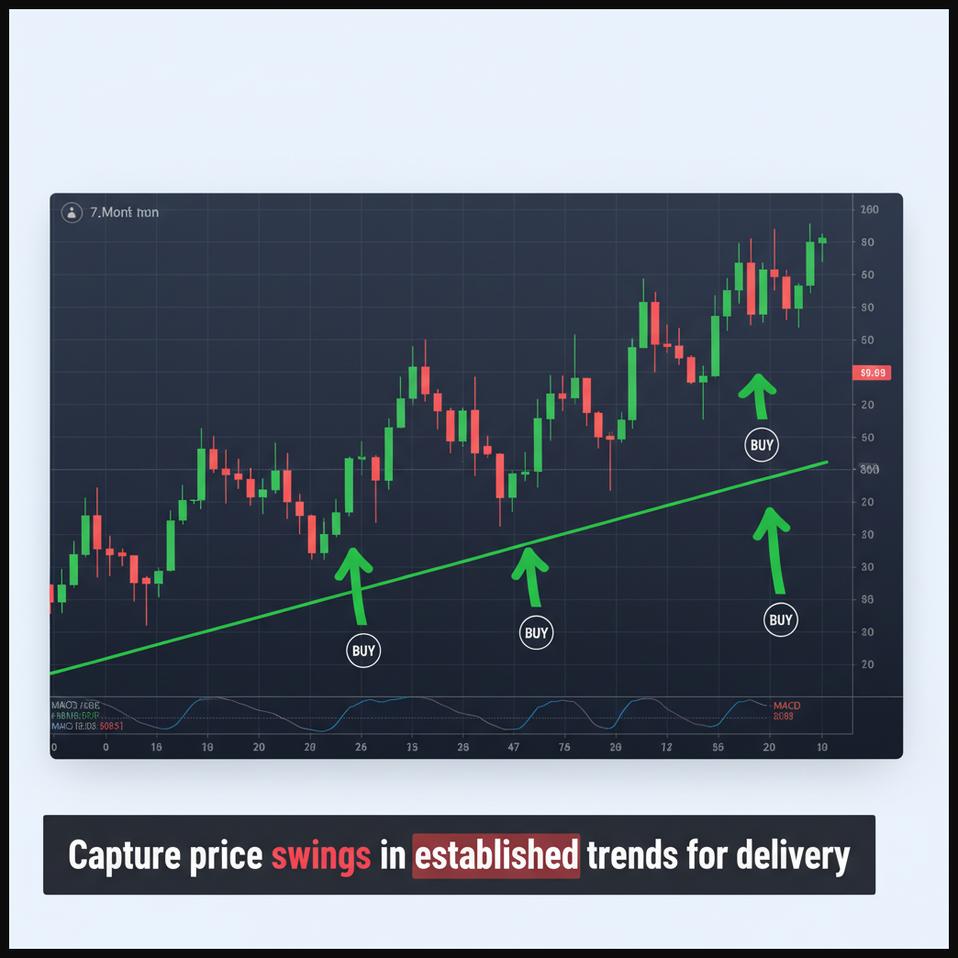
While typically a short-to-medium term strategy, swing trading principles can be adapted for delivery. This involves capturing “swings” in price within an established trend, holding positions for a few days to several weeks. For delivery, these swings are identified on longer timeframes.
A delivery trading setup with a swing approach seeks to enter long positions at the bottom of a pullback within an uptrend or short positions at the top of a bounce within a downtrend, taking delivery of the shares. The goal is to profit from the immediate directional movement, contributing to a larger long-term position.
| Action | Trend Context | Holding Period |
|---|---|---|
| Buy (Long) | Pullback in Uptrend | Days to Weeks (Delivery) |
| Sell (Exit) | Bounce in Downtrend | Days to Weeks (Delivery) |
12. Channel Trading Setups

Channel trading is a technical analysis delivery setup where a stock’s price consistently moves between two parallel trendlines, forming a channel. Traders look to buy near the lower trendline (support) and sell near the upper trendline (resistance).
For delivery, this means holding the position as the price oscillates within the channel, taking profits at the upper bound or adding at the lower. Identifying reliable channels on a stock market delivery trading chart allows for predictable entry and exit points, especially in sideways or gently trending markets in 2026.
| Price Action | Channel Boundary | Strategy |
|---|---|---|
| Approaching Lower Line | Support | Buy for Delivery |
| Approaching Upper Line | Resistance | Consider Partial Profit Booking |
13. Fibonacci Retracement Strategy

Fibonacci retracement is a popular delivery trading strategy used to identify potential support and resistance levels where a stock’s price might reverse after a significant move. Common retracement levels are 38.2%, 50%, and 61.8%.
Traders use these levels to anticipate pullbacks within an uptrend, looking for entry points for long-term delivery positions. A bounce from a Fibonacci level, confirmed by other indicators, can offer a high-probability entry for profitable delivery trades, allowing investors to add to their holdings at favorable prices in 2026.
| Fibonacci Level | Interpretation | Action |
|---|---|---|
| 38.2% / 50% / 61.8% | Potential Support after Rally | Entry Point for Delivery |
| Extension Levels | Potential Resistance after Breakout | Profit Target Consideration |
14. Divergence Trading with MACD

Divergence trading using the Moving Average Convergence Divergence (MACD) indicator is a powerful technical analysis delivery setup. It occurs when the price of an asset moves in one direction, but the MACD indicator moves in the opposite direction.
Bullish divergence (price making lower lows, MACD making higher lows) suggests weakening bearish momentum and a potential uptrend reversal, offering a delivery buying opportunity. Bearish divergence (price making higher highs, MACD making lower highs) signals weakening bullish momentum and a potential downtrend, prompting caution for long-term holdings in 2026.
| Type of Divergence | Price Action | MACD Action | Implication |
|---|---|---|---|
| Bullish | Lower Lows | Higher Lows | Potential Uptrend Reversal |
| Bearish | Higher Highs | Lower Highs | Potential Downtrend Reversal |
15. Relative Strength Trading

Relative strength trading is a delivery trading strategy where investors identify stocks or sectors that are outperforming the broader market or their peers. This involves comparing the price performance of a specific stock against an index or other stocks over a period.
The core idea is that stocks exhibiting strong relative strength are likely to continue their outperformance. Identifying these leaders for delivery in 2026 allows traders to ride strong trends and participate in the most dynamic parts of the market, focusing on assets with proven upward momentum.
| Comparison | Observation | Strategy |
|---|---|---|
| Stock vs. Index | Stock outperforming | Buy Strongest Performers |
| Sector vs. Market | Sector showing leadership | Invest in Leading Sectors |
16. Price Action Trading (Pure)

Pure price action trading is a delivery trading setup that relies solely on the interpretation of price movements on a chart, without the use of indicators. Traders analyze candlestick patterns, support and resistance levels, trendlines, and chart patterns to make decisions.
This approach emphasizes understanding market psychology directly from the price itself. For long-term delivery, identifying strong impulses, healthy corrections, and significant turning points through price action alone provides a clear and unfiltered view of market dynamics, making it a powerful tool for 2026.
| Analytical Tool | Focus | Decision Basis |
|---|---|---|
| Candlestick Patterns | Market Sentiment | Entry/Exit Signals |
| Support/Resistance | Supply/Demand Zones | Turning Points |
17. Gap Up/Down with Confirmation

Gap trading for delivery involves analyzing stocks that “gap up” or “gap down” at the open, meaning the opening price is significantly higher or lower than the previous day’s close. These gaps often occur due to news, earnings, or other significant events.
For a profitable trading strategy setup, traders look for gaps that occur with strong volume and then confirm the direction with subsequent price action. A gap up that holds and continues higher often signals a strong underlying bullish sentiment, suitable for initiating a delivery position in 2026, or vice versa for a gap down.
| Gap Type | Confirmation | Implication |
|---|---|---|
| Gap Up | Sustained Price Action, High Volume | Strong Buy Signal |
| Gap Down | Sustained Price Action, High Volume | Strong Sell Signal (Avoid Long) |
18. Volatility-Based Entries

Volatility-based entries are a delivery trading strategy that capitalizes on periods of high or low market volatility. Tools like Bollinger Bands or the Average True Range (ATR) are used to measure the degree of price fluctuations.
For delivery, traders might look to enter positions when volatility is contracting (e.g., Bollinger Band squeeze), anticipating a sharp directional move once volatility expands. Conversely, extremely high volatility might signal a market extreme and a potential reversal, offering opportunities for strategic entry or exit for profitable delivery trades in 2026.
| Volatility Condition | Indicator | Strategy |
|---|---|---|
| Contracting Volatility | Bollinger Bands Squeeze | Anticipate Breakout, Position for Delivery |
| Expanding Volatility | High ATR | Ride Trend or Expect Reversal |
19. Earnings Season Plays (Long-Term View)

While earnings reports often cause short-term volatility, they can also provide delivery trading setups for long-term investors. This involves analyzing a company’s earnings reports not just for the immediate results, but for insights into its future growth prospects and fundamental health.
Identifying companies that consistently beat expectations, provide strong forward guidance, or demonstrate improving financials can signal a profitable trading strategy setup for long-term delivery. Investors might use post-earnings pullbacks in strong companies as buying opportunities, aiming to capitalize on sustained growth beyond 2026.
| Event | Analysis Focus | Delivery Strategy |
|---|---|---|
| Earnings Report | Future Growth Prospects, Guidance | Buy on Post-Earnings Pullback |
| Consistent Beats | Company Strength | Hold/Add to Position |
20. Corporate Action-Driven Trades

Corporate actions like stock splits, buybacks, mergers, or acquisitions can create unique delivery trading setups. These events often fundamentally change a company’s structure or valuation, offering strategic entry or exit points for long-term investors.
For instance, a share buyback program can reduce the number of outstanding shares, increasing earnings per share and potentially boosting the stock price over time, making it a profitable delivery trade. Thorough research into the implications of such actions in 2026 is crucial to leverage these opportunities effectively for your delivery portfolio.
| Corporate Action | Potential Impact | Delivery Decision |
|---|---|---|
| Share Buyback | Increased EPS, Price Appreciation | Consider Long-Term Holding |
| Acquisition | Synergies, Growth Potential | Evaluate Combined Entity |
21. Option Hedging for Delivery Positions

While delivery trading focuses on holding stocks, using options to hedge existing long-term positions can be a smart delivery trading strategy. This involves buying protective put options on a portion of your delivery holdings to limit potential downside risk without selling your shares.
This profitable trading strategy setup allows investors to protect their accumulated gains during periods of high market uncertainty or anticipated volatility. It provides insurance for your delivery portfolio, ensuring that temporary market downturns in 2026 don’t erase significant long-term profits.
| Tool | Purpose | Application |
|---|---|---|
| Protective Put Options | Downside Protection | Hedge Delivery Holdings |
| Covered Calls | Generate Income | On Existing Long Positions |
22. Pair Trading for Long-Term

Pair trading for delivery involves simultaneously going long on one stock and short on another, typically within the same sector, that are historically highly correlated but have temporarily diverged. The expectation is that the prices will eventually converge.
For a delivery trading setup, one takes a long delivery position in the undervalued stock and (conceptually) a short position in the overvalued one (or avoids it). This strategy aims to profit from the relative performance, neutralizing market risk. It’s a nuanced approach for sophisticated investors in 2026.
| Stocks | Relationship | Delivery Action |
|---|---|---|
| Stock A, Stock B | Historically Correlated, Temporarily Diverged | Buy Undervalued Stock A, Avoid Overvalued Stock B |
| Convergence | Prices Return to Mean | Profit from Relative Performance |
23. Economic Event-Driven Setups

Major economic events and data releases, such as interest rate decisions, inflation reports, or GDP figures, can significantly influence market sentiment and create delivery trading setups. Understanding their potential impact is key for long-term investors.
For instance, positive economic data might signal a healthy growth environment, making certain sectors more attractive for long-term delivery in 2026. Conversely, negative news might prompt caution or a reallocation of capital. Staying informed and interpreting these events correctly is vital for profitable delivery trades.
| Economic Event | Potential Impact | Delivery Strategy |
|---|---|---|
| Interest Rate Hike | Negative for Growth Stocks, Positive for Banks | Adjust Sector Allocations |
| Strong GDP Growth | Positive for Broader Market | Consider Expansion-Sensitive Sectors |
24. Ichimoku Cloud Setups

The Ichimoku Cloud is a comprehensive technical analysis delivery setup that provides support and resistance levels, trend direction, and momentum information on a single chart. It is particularly effective for identifying long-term trends and potential reversal points.
For delivery traders, a stock trading above the Ichimoku Cloud with the cloud acting as support, and the Tenkan-sen (conversion line) above the Kijun-sen (base line), signals a strong bullish trend. This offers robust entry signals for profitable delivery trades, especially for positions intended to be held through 2026.
| Ichimoku Component | Signal | Delivery Action |
|---|---|---|
| Price above Cloud | Bullish Trend | Buy Signal |
| Cloud acts as Support | Confirmation of Trend Strength | Hold/Add to Position |
25. Bollinger Band Squeeze/Expansion

Bollinger Bands are a delivery trading strategy tool that measures market volatility. A “squeeze” occurs when the bands narrow significantly, indicating low volatility and often preceding a period of high volatility and a potential breakout.
Conversely, “expansion” happens when the bands widen, suggesting increased volatility and a strong trend. For long-term delivery, identifying a squeeze and positioning before an expansion can lead to profitable delivery trades as the price makes a decisive move. This is a predictive setup for 2026 trend identification.
| Bollinger Band Action | Interpretation | Delivery Strategy |
|---|---|---|
| Bands Squeeze | Low Volatility, Imminent Breakout | Prepare for Directional Move |
| Bands Expand | High Volatility, Strong Trend | Ride the Established Trend |
26. Multi-Timeframe Analysis
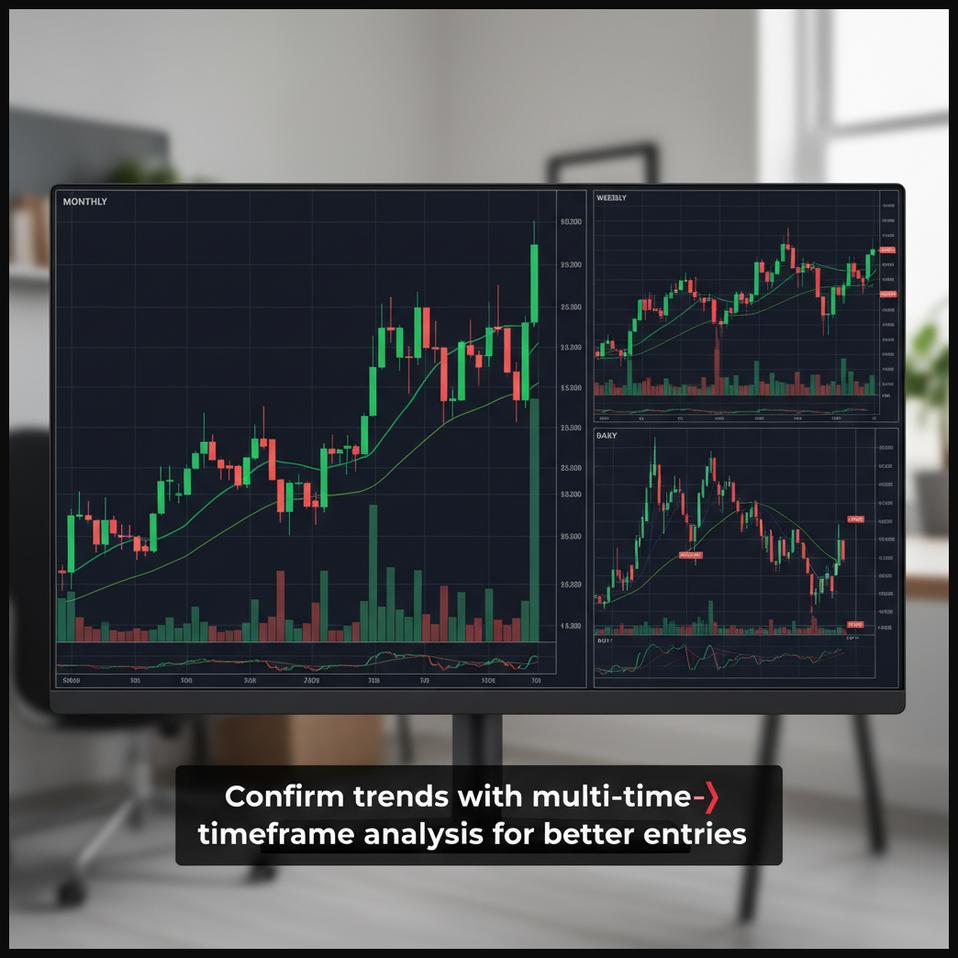
Multi-timeframe analysis is a crucial delivery trading setup that involves examining a stock’s price action across different timeframes (e.g., daily, weekly, monthly charts). This helps confirm trends and identify stronger support/resistance levels.
For a profitable trading strategy setup, a long-term delivery trader might identify a bullish trend on a monthly chart, then use the weekly chart to find optimal entry points during pullbacks, and finally, the daily chart for precise timing. This holistic view provides a clearer perspective for positions planned through 2026.
| Timeframe | Focus | Contribution to Strategy |
|---|---|---|
| Monthly Chart | Long-Term Trend | Overall Direction Confirmation |
| Weekly Chart | Medium-Term Swings, Major S/R | Entry/Exit Zone Identification |
27. Smart Money Concept for Delivery

The “Smart Money Concept” (SMC) is an advanced delivery trading setup that attempts to identify the footprints of institutional traders (smart money) in the market. This involves analyzing order blocks, liquidity gaps, and fair value gaps to anticipate their moves.
For long-term delivery, SMC traders look for areas where institutions have accumulated or distributed shares, providing insights into potential future price movements. Understanding these institutional flows, especially for large positions held through 2026, can provide a significant edge for profitable delivery trades.
| SMC Element | Interpretation | Delivery Implication |
|---|---|---|
| Order Blocks | Institutional Buy/Sell Zones | High Probability Entry/Exit |
| Liquidity Gaps | Price Imbalances | Areas for Price Reversal/Fill |
28. Risk-Adjusted Portfolio Builds

A delivery trading strategy is incomplete without a robust approach to risk-adjusted portfolio building. This involves allocating capital across various assets based on their risk-return profiles, aiming to maximize returns for a given level of risk or minimize risk for a target return.
For 2026, investors should diversify across different sectors, asset classes, and geographies to reduce concentration risk. This involves regularly rebalancing the portfolio to maintain desired allocations, ensuring that no single profitable trading strategy setup or stock unduly impacts overall returns.
| Component | Purpose | Consideration |
|---|---|---|
| Diversification | Reduce Concentration Risk | Across Sectors, Geographies |
| Rebalancing | Maintain Target Allocation | Periodic Adjustments |
29. Macro-Economic Theme Investing

Macro-economic theme investing is a delivery trading setup where investors identify broad, long-term economic trends and invest in companies or sectors that are poised to benefit from these trends. Examples include renewable energy, artificial intelligence, or an aging population.
This strategy requires a deep understanding of global economic forces and foresight to identify themes that will drive growth for decades. For 2026 and beyond, positioning a delivery portfolio around these powerful themes can lead to significant long-term capital appreciation, leveraging structural shifts in the economy.
| Macro Theme | Example | Delivery Investment |
|---|---|---|
| Energy Transition | Renewable Energy Adoption | Solar, Wind Power Companies |
| Digital Transformation | AI, Cloud Computing | Tech Innovators |
30. Compounding through Reinvestment

The power of compounding is a fundamental aspect of any delivery trading strategy and forms a key setup for long-term wealth creation. This involves reinvesting any dividends or profits back into your portfolio, allowing your returns to generate further returns.
Over extended periods, especially through 2026, the effect of compounding can be exponential, significantly boosting the total value of your delivery holdings. It requires discipline and a long-term mindset, but it’s arguably the most profitable trading strategy setup for building substantial wealth in the stock market.
| Action | Effect | Time Horizon |
|---|---|---|
| Reinvest Dividends | Increased Share Holdings | Long-Term |
| Reinvest Profits | Accelerated Portfolio Growth | Exponential Growth |
FAQs
Q1. What is the most important factor for successful delivery trading?
The most important factor for successful delivery trading is a combination of thorough research, patience, and disciplined execution. Understanding the underlying business and market dynamics, coupled with the ability to hold positions through market fluctuations, is crucial for long-term profitability. Avoiding emotional decisions and sticking to your predefined strategy will serve you well in 2026.
Q2. How do I choose the best delivery trading setup for myself?
Choosing the best delivery trading setup depends on your individual risk tolerance, investment horizon, and knowledge level. It’s recommended to start with simpler strategies like trend following or value investing, and gradually explore more complex setups as you gain experience. Experiment with different approaches in 2026 to see what aligns best with your financial goals.
Q3. Are these delivery trading strategies suitable for all market conditions?
While many of these delivery trading strategies are robust, no single setup is universally suitable for all market conditions. Some strategies, like trend following, perform better in trending markets, while others, like value investing, may shine in sideways or volatile markets. Adapting your approach based on the prevailing market environment in 2026 is key.
Q4. What role does risk management play in delivery trading?
Risk management plays an absolutely critical role in delivery trading. It involves setting appropriate stop-losses, diversifying your portfolio, and only risking a small percentage of your capital on any single trade. Effective risk management protects your capital during unfavorable market movements and ensures the longevity of your trading journey, especially in 2026.
Conclusion
Navigating the complexities of delivery trading effectively requires a blend of strategic insight and disciplined execution. The 30 setups discussed here provide a comprehensive framework for identifying and capitalizing on long-term opportunities in the stock market. By mastering these delivery trading strategies, investors can build robust portfolios designed for sustained growth and profitability.
As we look ahead to 2026, the principles of patience, thorough analysis, and prudent risk management remain paramount. Embrace these strategies, continuously refine your approach, and empower your journey toward achieving your long-term financial objectives with profitable delivery trades.
Also Check:- Dustin Anderson Comedian Age